Pain 01
27 minutes per client.
Time that should have gone to high-value guidance was spent on manual research.
An AI-powered career-coaching dashboard that reduced session research by 62%, by giving coaches context they could trust, not recommendations they had to second-guess.
Career coaches at Workforce Singapore were spending 27 minutes per client manually researching occupation and industry trends, and still walking into sessions under-equipped. Clients expected domain expertise no coach can realistically hold across every industry.
I led UX on this project end to end over 12 months, from the initial proofs of concept through problem reframing, the modular system design, and validation with public users and coaches. The work spanned design research (interviews, surveys, usability validation), interaction and information design for the signal framework and dashboard, and close collaboration with WSG stakeholders through to an accelerated rollout decision.
Industry Occupation Insights (I/O Insights) closed that gap. It is a modular, signal-based dashboard that gives coaches real-time industry context, including demand, wage movement, growth outlook, and career pathways, assembled per session and shareable live with clients. Coaches reported a 62% reduction in research time per client, from 27 minutes down to 10, and WSG's ACE division requested an accelerated rollout, a rare outcome for a government technology project.
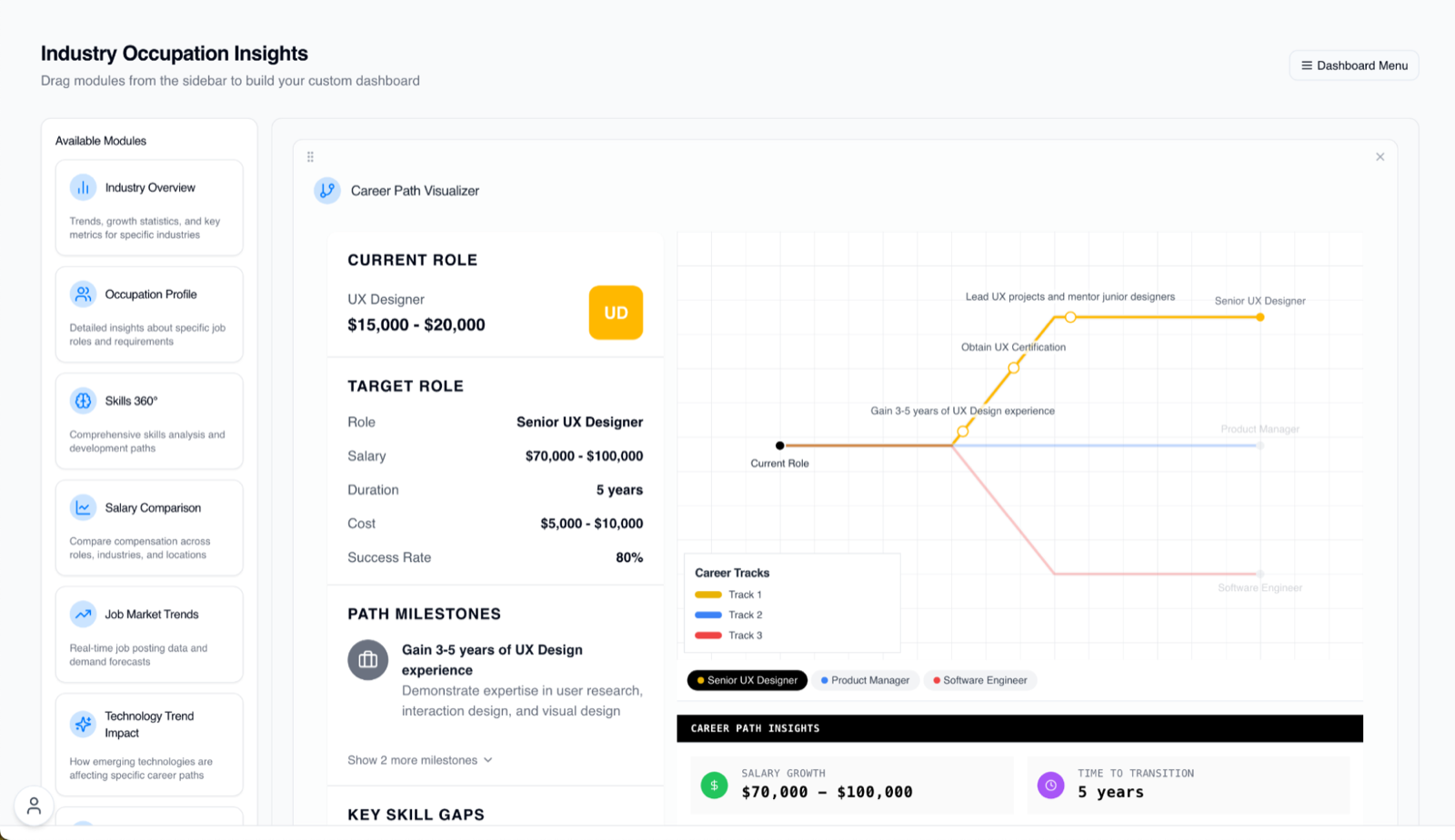
Coaches were caught in an information asymmetry. Clients assumed they knew specific jobs and industries in depth; in reality, no one has lived experience of every occupation. The existing tools made this worse, not better. They returned job listings and dense text blocks, not the contextual signal a coach needs to decide whether an industry is worth recommending in the next ten minutes of a conversation.
Time that should have gone to high-value guidance was spent on manual research.
No fast way to get up to speed on an unfamiliar industry or role. Clients expected domain expertise coaches didn't have.
Existing tools presented walls of text and raw listings, leaving coaches to interpret on the fly.
Job seekers' needs were highly diverse, but the tools offered little control over what was shown.
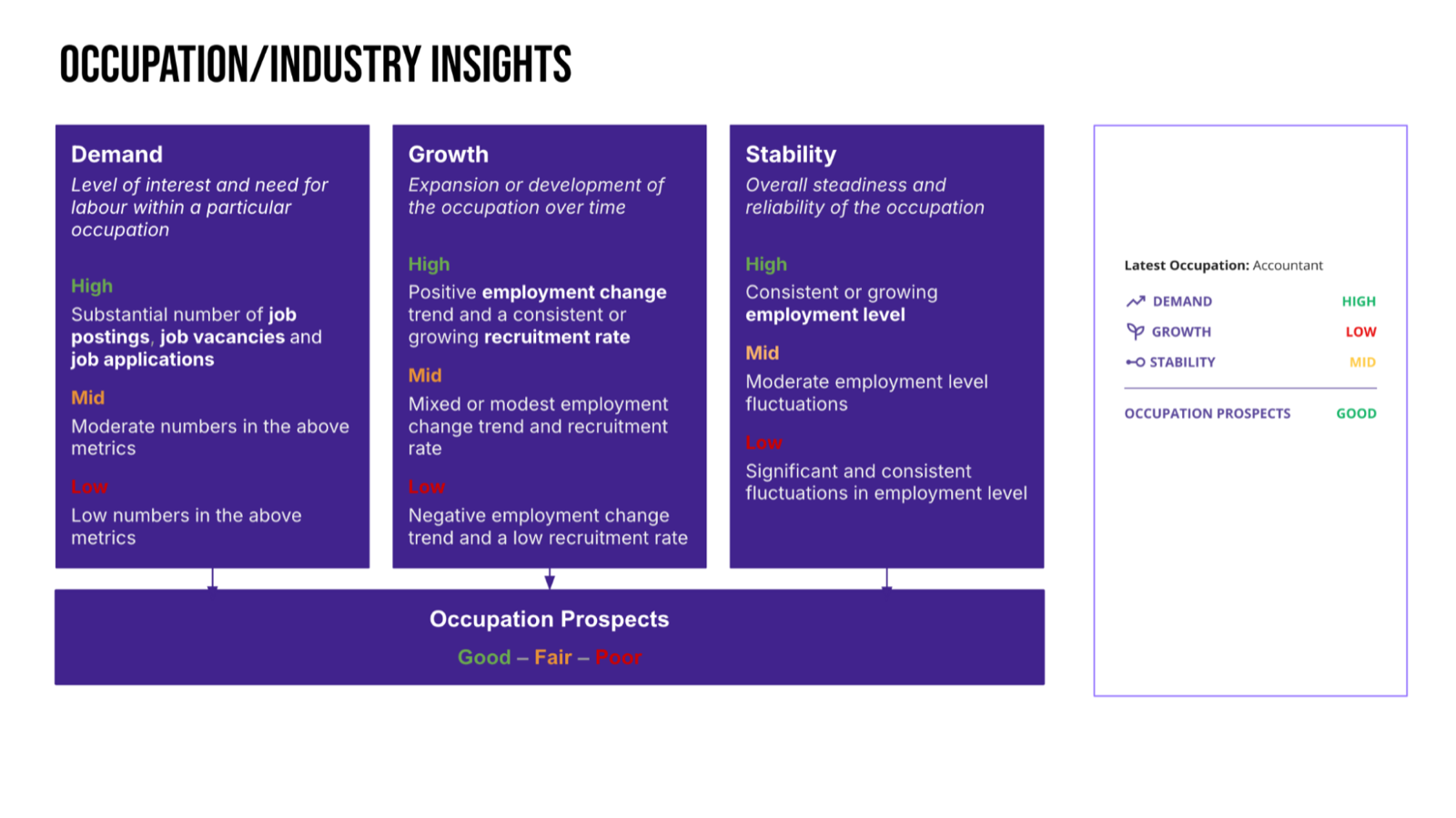
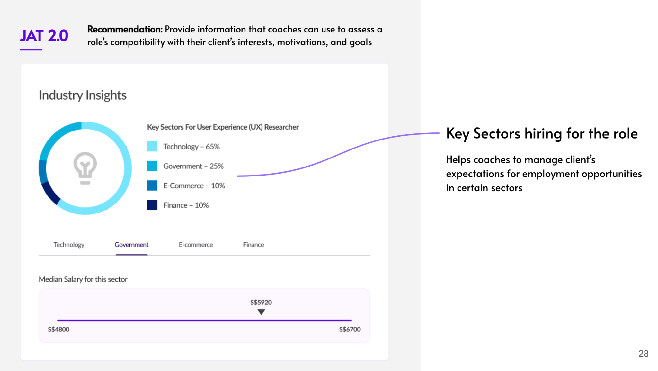
Rather than dumping data, we distilled publicly available metrics into three readable signals: demand, wage movement, and growth outlook. A coach can assess in seconds whether an industry is worth raising with a job seeker.
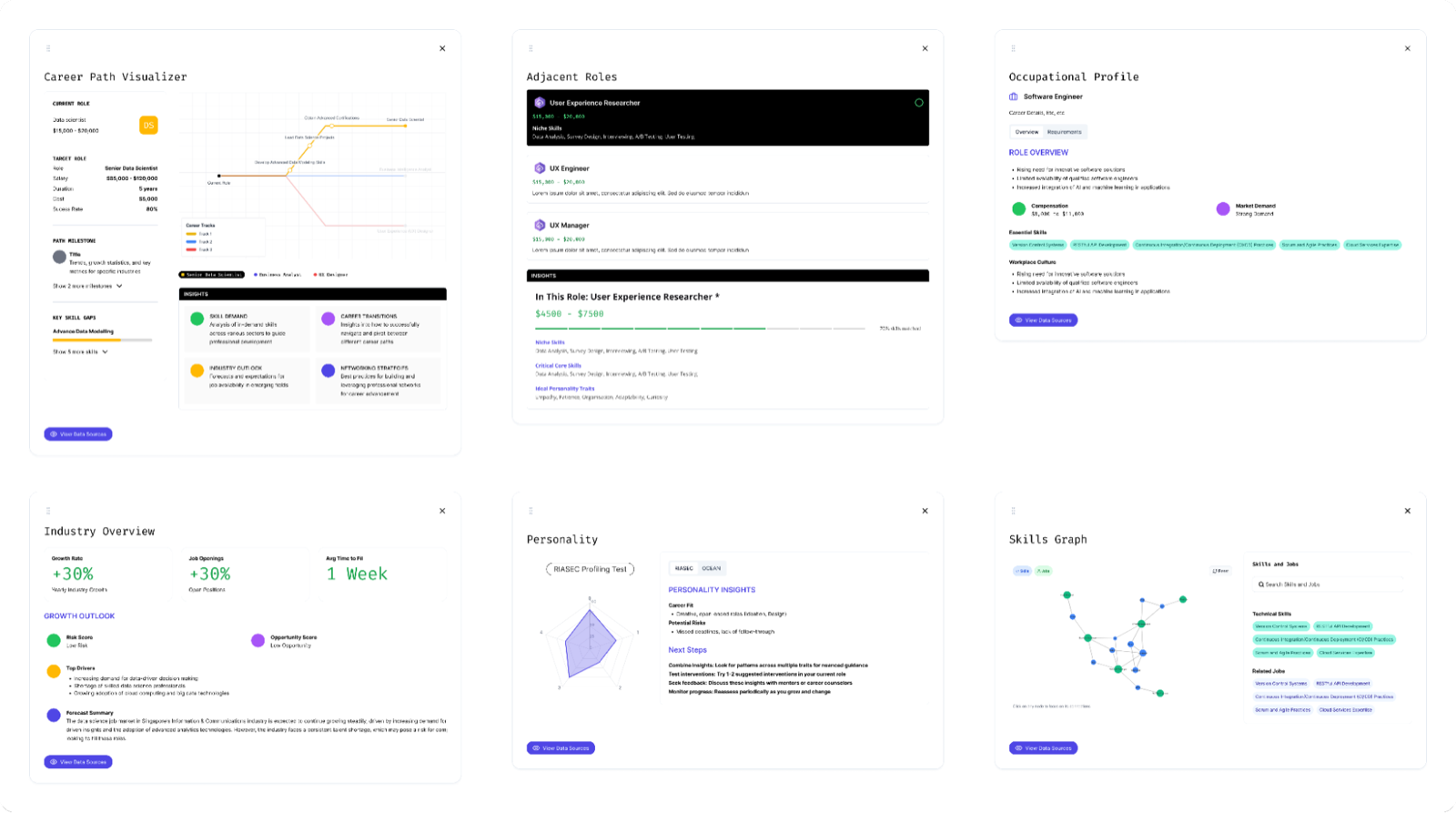
Each insight is a self-contained widget: industry trends, salary benchmarks, career pathways, skill analysers. Coaches arrange them into session-specific layouts, save configurations for common client profiles, and share the dashboard live with clients for collaborative exploration.
The product that shipped looks obvious in hindsight. It wasn't. It took three iterations, each one correcting an assumption from the last.
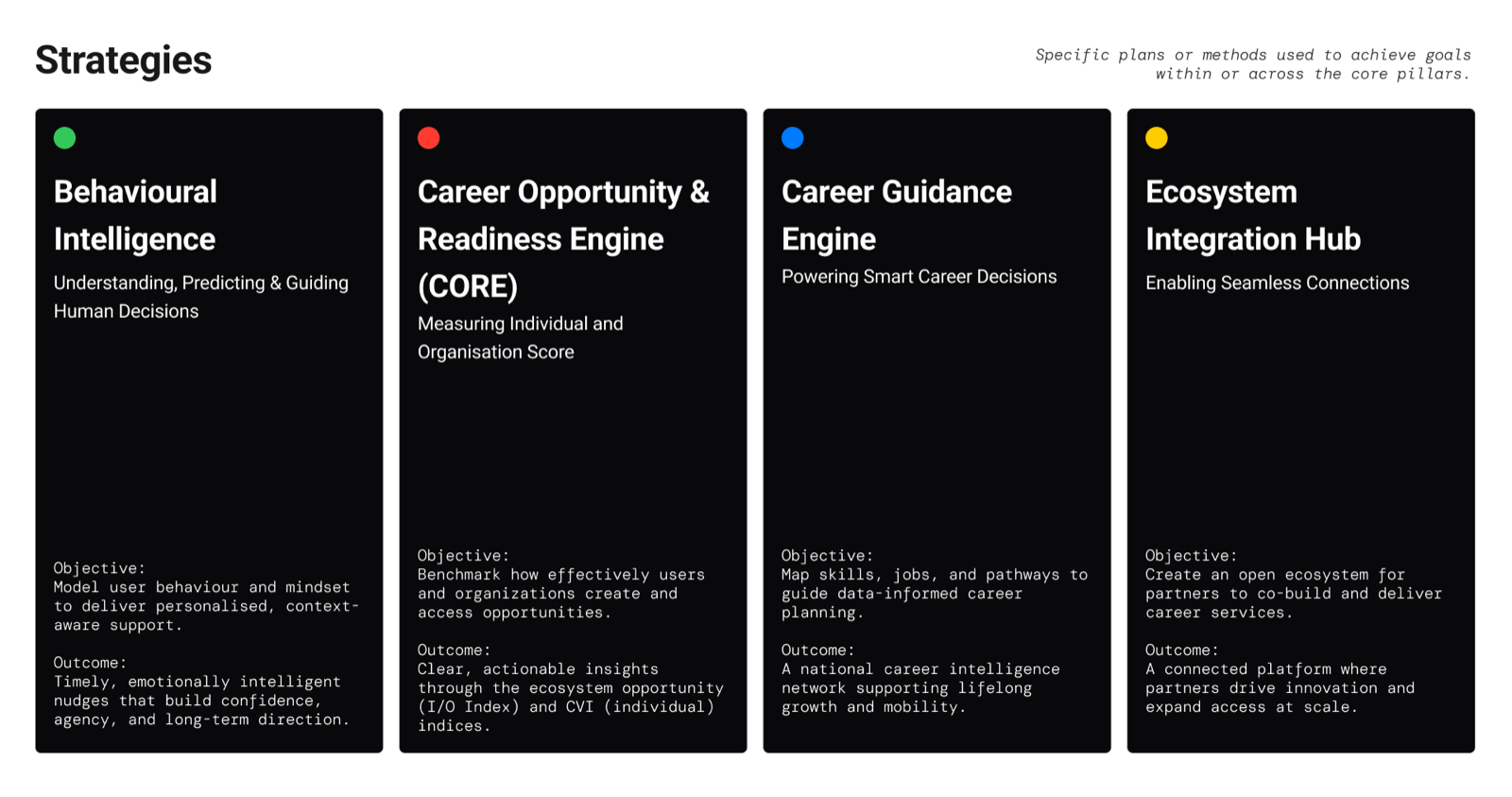
The project sits within WSG's broader career ecosystem, anchored by four core pillars. These are not abstractions. They set the boundaries for every design decision: understand behaviour before prescribing action, make opportunity visible and measurable, build tools that adapt to shifting futures, and design for an ecosystem rather than a single platform.
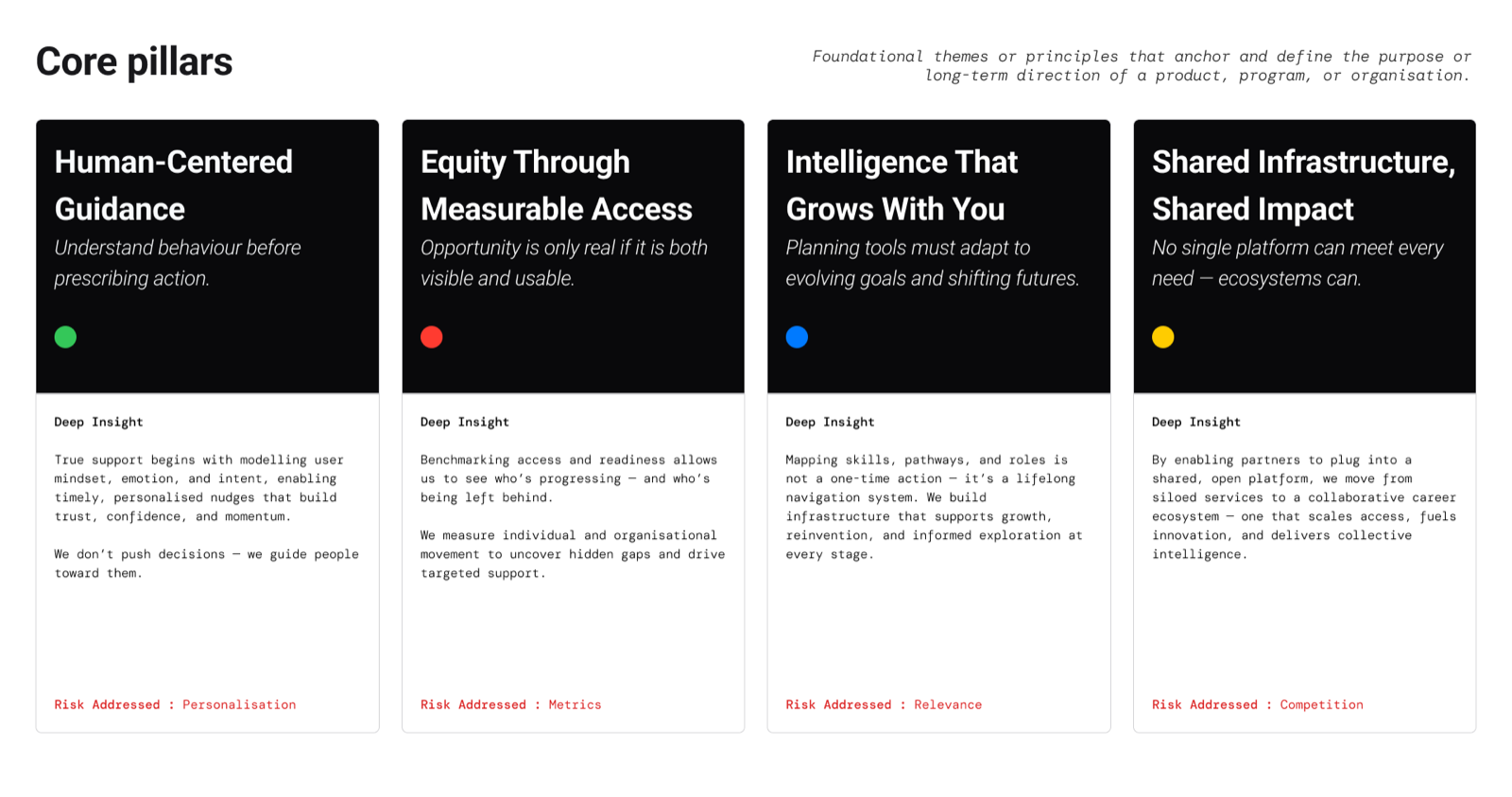
Each pillar translates into a concrete strategy. Behavioural Intelligence shaped how the dashboard models coach decision-making. The CORE engine defined the metrics layer. The Career Guidance Engine became the I/O Insights product itself, mapping skills, jobs, and pathways into actionable views. The Ecosystem Integration Hub ensured the system could connect to partners and scale beyond a single use case.
Instead of the system generating recommendations, we provide coaches with clear, comprehensive information to enable their informed decisions. The coach is always in control.
A drag-and-drop interface with customisable modules: industry trends, salary benchmarks, career pathways, skill requirements. Coaches tailor dashboards to each session.
Research time has dropped substantially with the use of I/O, yet most users perceive no change, suggesting the time savings are not yet consistently felt.
Most coaches find the tool moderately useful, consistent with its genuine but situational value. It is used selectively for specific client profiles and coaching contexts rather than as a routine resource.
The project established the foundation for the broader Career Portal initiative, extending the approach toward policymakers, employers, and educational institutions.
The I/O system holds significant potential beyond career coaching, offering insights for policymakers, employers, educational institutions, and job seekers directly. The foundation is built for scale.
The thing I carry forward from this project is not the metric, it's the mechanism behind it.
I/O Insights minimised effort and maximised the coach's sense of control at the same time, and it did so specifically because construction stayed in human hands. The survey data tells a subtler story: research time dropped 62%, but most coaches didn't perceive the change, and usefulness rated 2.75 out of 5. These are not contradictions. They are evidence that the tool's value is situational, not universal, and that the perception of usefulness lags behind the reality of time savings. Trust didn't come from the intelligence of the system. It came from the legibility of it: coaches could see where every signal originated and decide what to do with it.
That observation is what pulled me toward research on human agency in AI-mediated tools: the question of how much a system can do for someone before it starts doing it to them.
The shipped product sits at the manual, human-controlled end of a much larger design space. The interesting research question is whether newer LLM and agentic capabilities can take on more of the construction work without spending the trust the manual version earned.
Split the data path: retrieval over unstructured material (chunked and cited), and an agent that queries an owned, validated database for structured figures. The system may shape presentation; it may not invent numbers. This auditable foundation is the precondition for letting AI build anything a coach has to defend to a client.
Let a coach state intent in plain language and have a judgment layer select and arrange the right widgets, collapsing drag-and-drop into a sentence. The open risk is whether describing genuinely reduces effort or merely relocates it into a correction loop.
Compose session-ready views from the component library rather than building each by hand, with the coach approving and adjusting rather than assembling from scratch.
Treat each coach correction as a scoped edit to a shared artifact rather than a full regeneration, so the dashboard accrues the coach's decisions the way manual assembly does, preserving authorship while removing labour.
Each of these reintroduces, carefully, the one thing the original deliberately avoided: the system deciding what the coach sees. The design research worth doing is finding how far that line can move before trust erodes, and which mechanisms (the verified substrate, scoped refinement, a visible seam between what AI may and may not touch) buy that authority back.