Pain № 01
Information asymmetry.
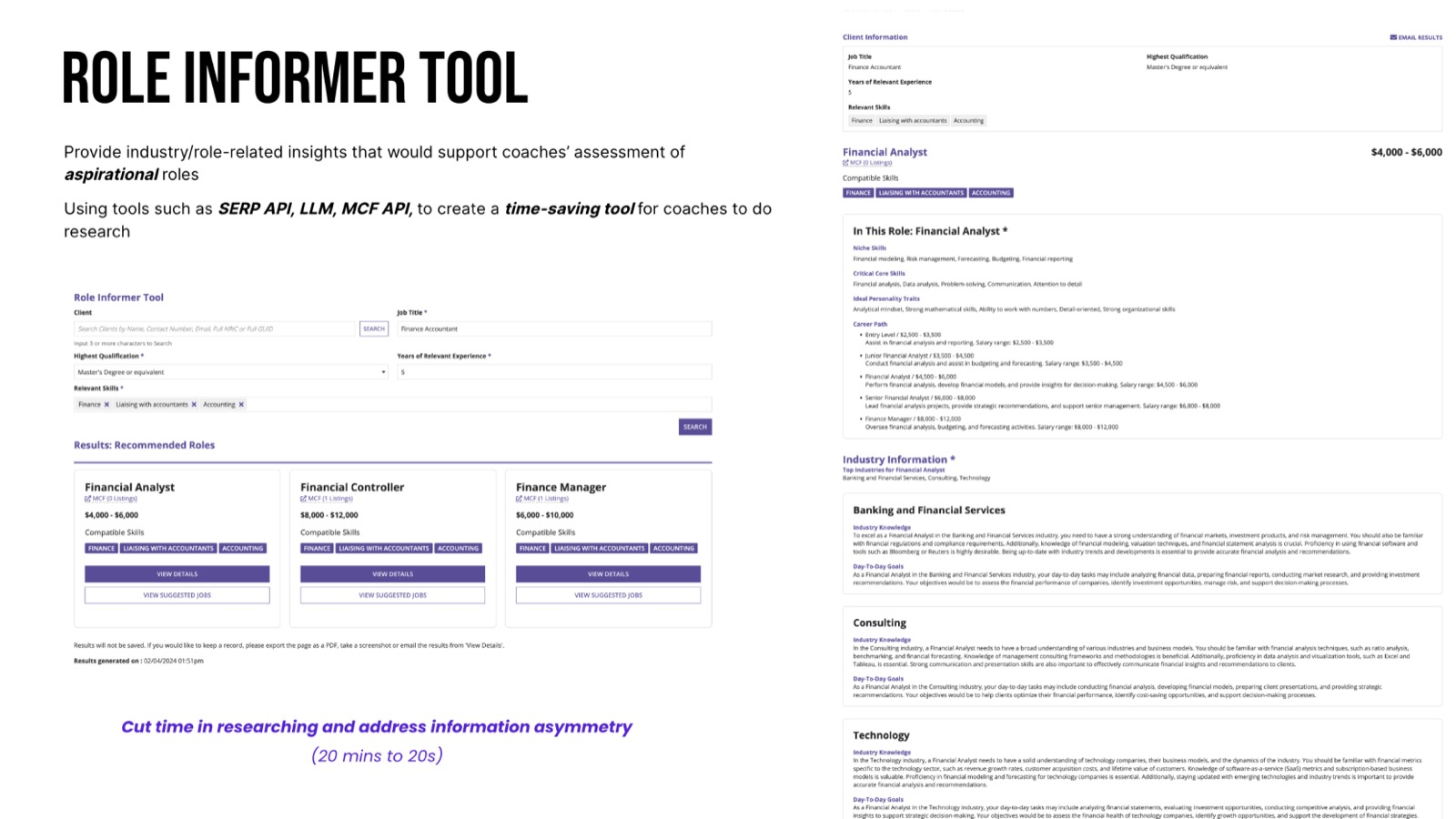
Coaches struggled with roles where they lacked domain expertise. They couldn't provide the context clients needed for unfamiliar industries or occupations.
A 12-to-16-month rework of Workforce Singapore's career coaching platform, co-created with coaches, powered by AI, and validated through quarterly usability cycles.
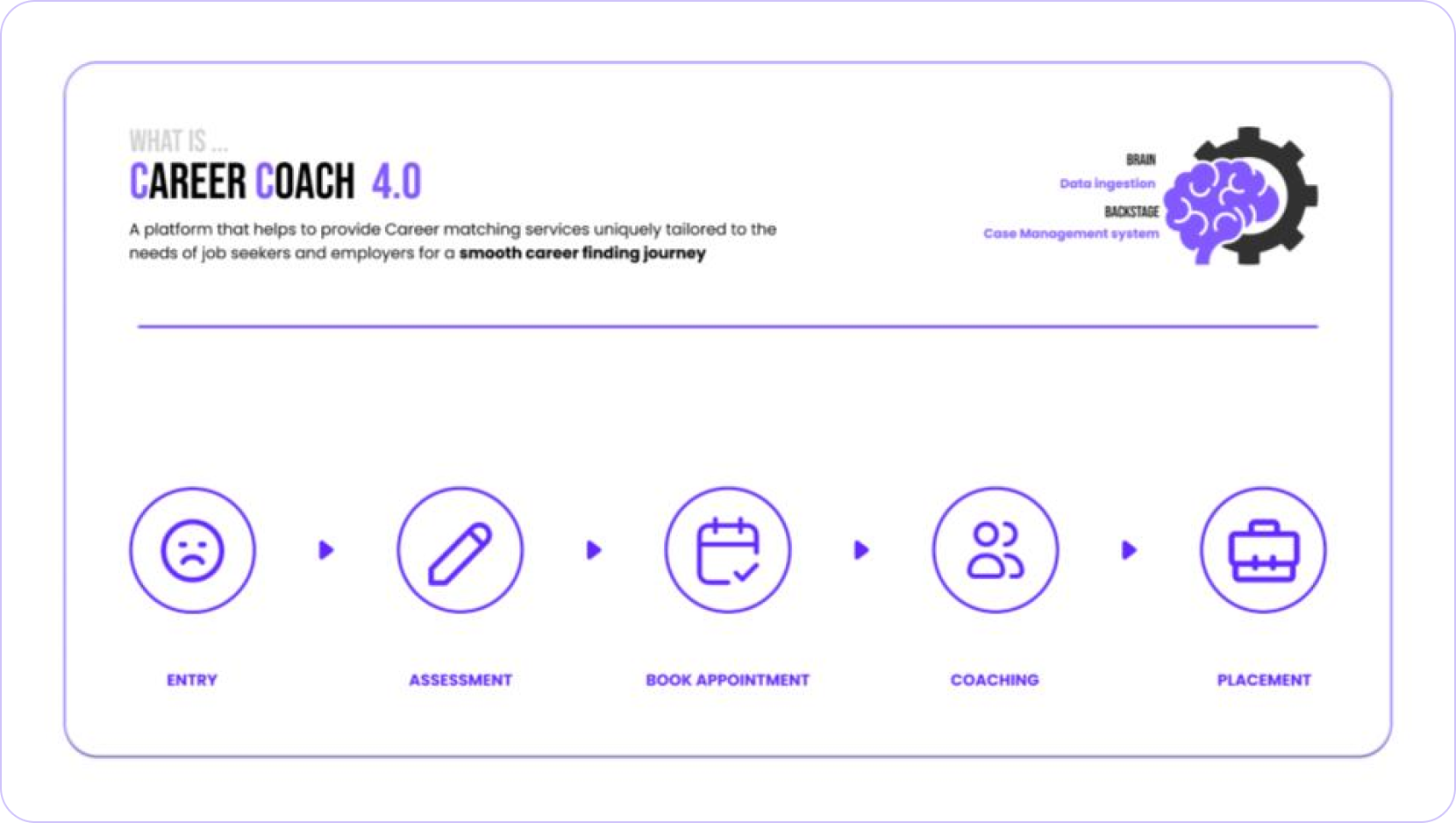
CC4.0, a collaboration between WSG and GovTech, serves as a platform for career coaches, offering tailored career matching services for job seekers at different career stages. It needed a major rework to meet increasing needs.
Career coaches struggled with tedious workflows, information asymmetry, and tools that didn't reflect how they actually worked. The platform needed to evolve from a data-entry system into a genuine coaching assistant.
Coaches struggled with roles where they lacked domain expertise. They couldn't provide the context clients needed for unfamiliar industries or occupations.
Manual data entry consumed time that should have been spent coaching. Multiple systems required duplicate entries with no data extraction between them.
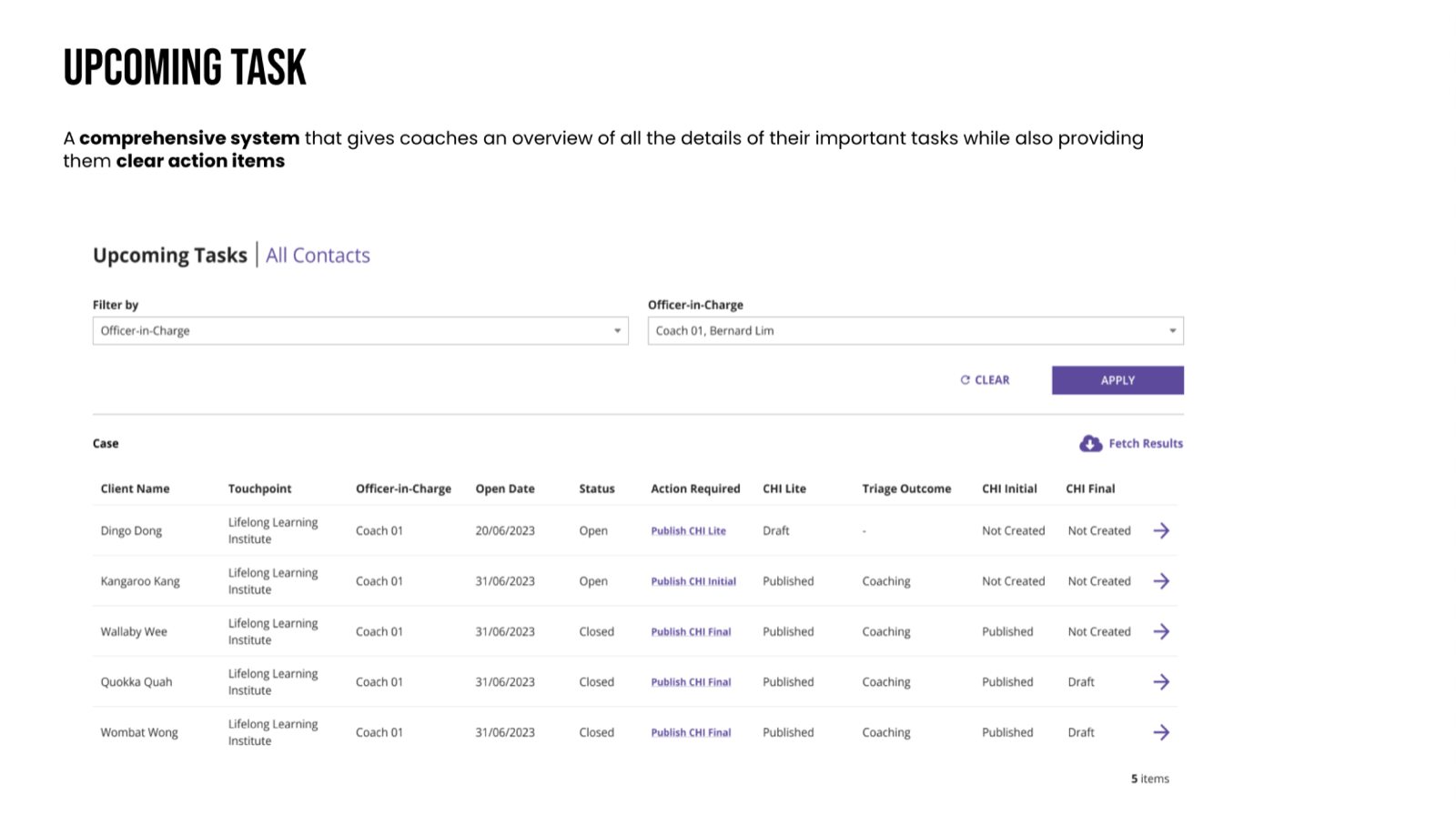
Coaches managed multiple clients simultaneously with no overview of their workload. Ensuring follow-through on the case management process was a constant challenge.
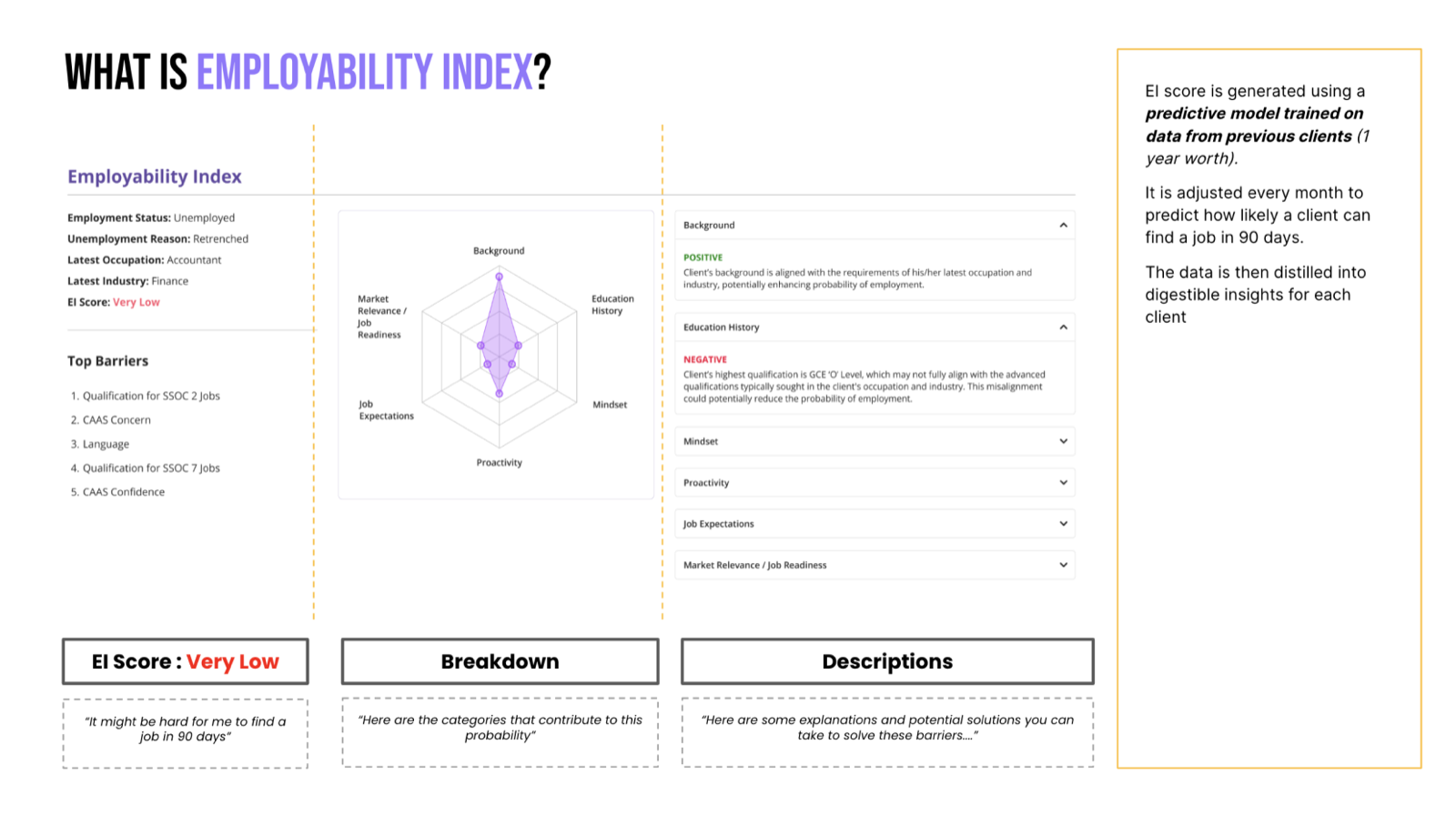
The platform tracked cases but didn't help coaches. There were no data-driven recommendations, no predictive models, no way to diagnose a client's employability.
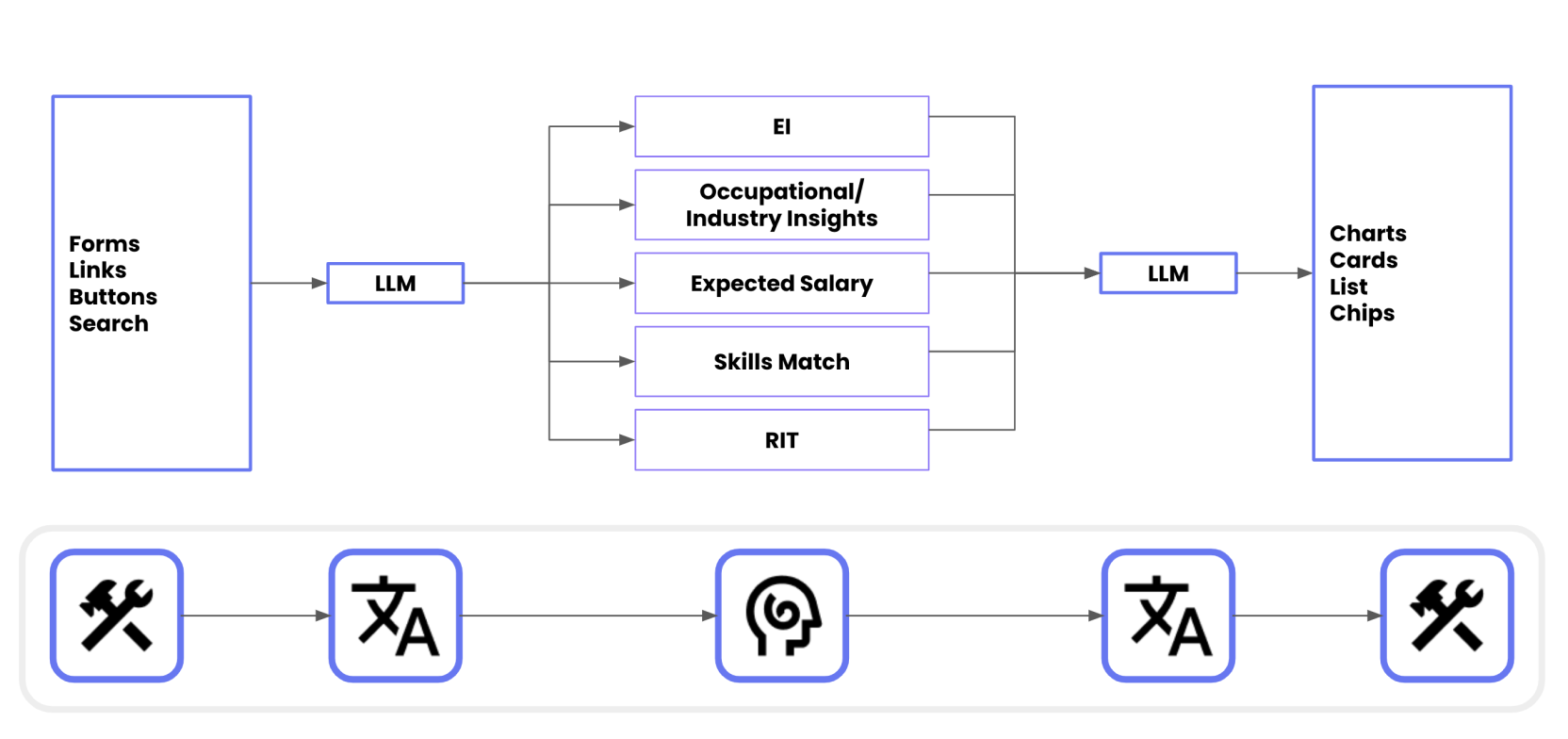
Coaches were often struggling with jobs where they lack domain expertise and lacked the context the clients needed. We solved this by creating a tool to combine SERP API and leveraged the capabilities of an LLM to help coaches reduce the efforts required to research roles they are unfamiliar with.
Coaches often shared their challenge of ensuring they are able to follow through the case management process as they have to deal with multiple clients at once. To help them with their work, we introduced two key features: Upcoming Tasks and an updated Banner System.
A significant outcome of the 360 Report was the development of the Employability Index, a data science initiative. Our team constructed a predictive model capable of determining the likelihood of a job seeker securing employment within 90 days, while also dissecting the contributing factors behind this outcome.
The data we use to create the Employability Index, while useful, is skewed as it is limited to the pool of clients that comes to WSG and E2i for coaching. We explored how we can use data sets from data.gov and mom.stat to discover insights on the industry to better inform coaches.
We started with the coaches, not with screens. Co-creation workshops, atomic research, and a consolidated IA gave us the blueprint for a 12-to-16-month execution roadmap.
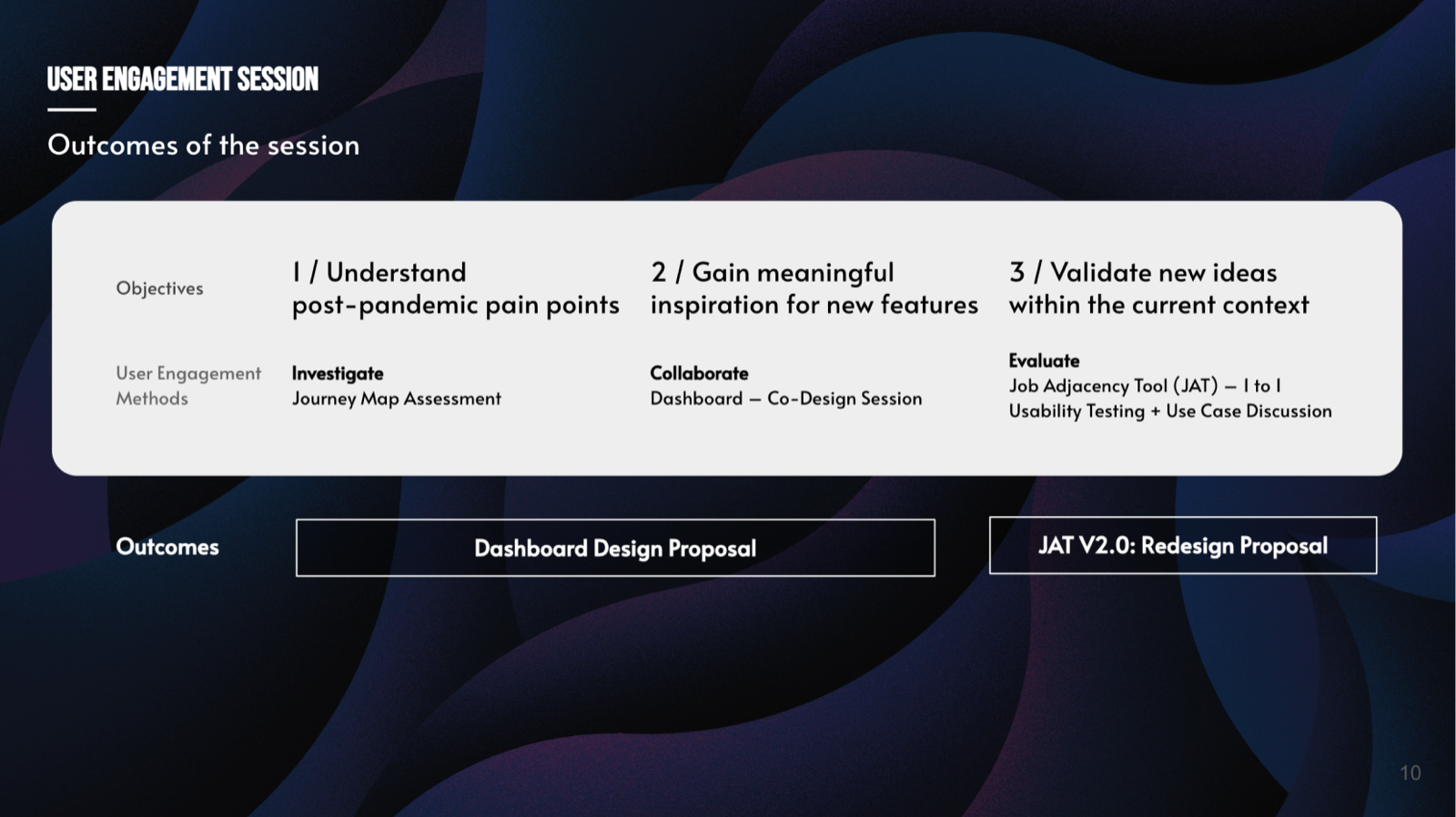
To gain valuable insights, we engaged in co-creation. This involved conducting a co-design workshop where we actively involved Career Coaches in discussions. Through various sessions, we delved into their pain points, fostering collaboration to explore potential ideas together.
I was able to derive invaluable insights by having the coaches design what they think they want their own dashboard to look like. We broke them into groups, printed out wireframes, drew and made notes and then had the groups share their ideas with each other. We then let them vote for the different designs and were able to see what issues resonated with the majority of the career coaches.
We used the atomic research framework to store our learnings in our research repository. By coding our research, we were able to construct a research dashboard for us to access our learnings easily. Through this process of co-creation and documentation, we were able to store what we learned and access those insights easily. This was vital as some of these improvements ended up taking about 12 to 16 months for us to implement.
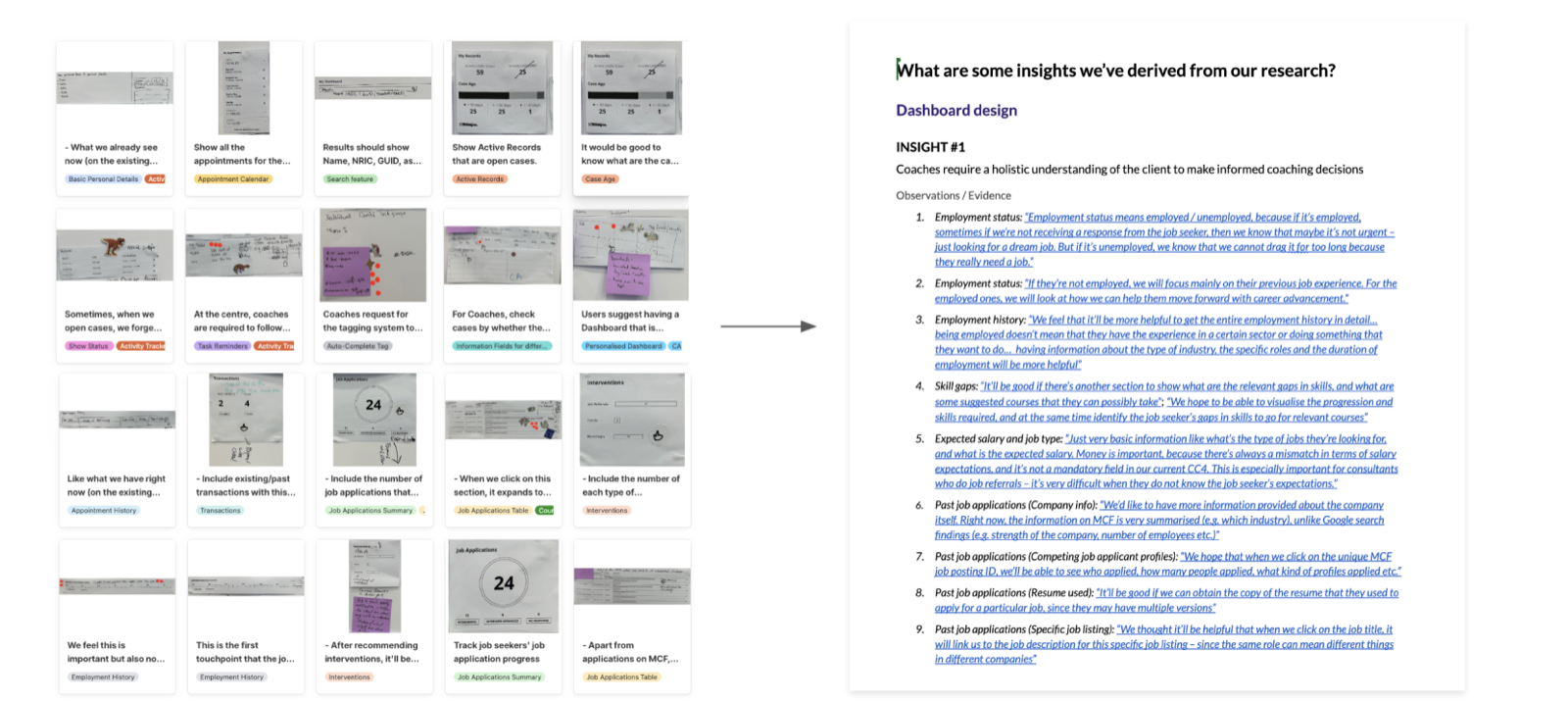
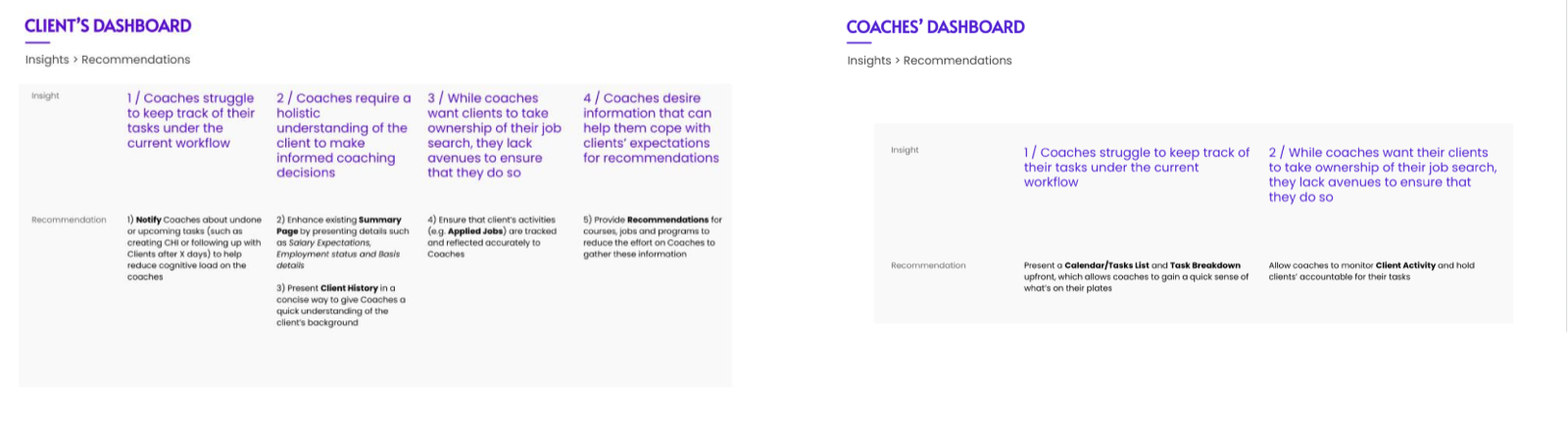
While the ideas that coaches had were useful, it was difficult to fit all of it into our UI. Instead, we extracted core themes in their "artwork" and used that to inform our decision to create a consolidated IA. This showed us what information was commonly used by coaches. The consolidated IA created a framework for us to think about what needed changing.
Based on these recommendations, I created a new design that matched what the coaches wanted. This redesign helped to act as the north star to the rework that would span the next 12 to 16 months. I presented these concepts to the group director of WSG and we were able to get buy-in and renew our project for another 2 years.
Combine SERP API and LLM capabilities to help coaches research unfamiliar roles in seconds, providing up-to-date, real-time job insights without the risks of raw LLM output.
Integrate external systems (FormSG, ABS) for client self-service. Extract data from existing sources to eliminate duplicate entry. Reduce cognitive load at every touchpoint.
Build the Employability Index: a predictive model using 60+ variables to determine likelihood of employment within 90 days. Turn data into coaching recommendations.
Over the span of a year, extensive research and execution processes were undertaken. Usability tests were conducted every three months, and numerous sessions were held with Centre Management, coaches, directors, and other stakeholders to ensure alignment with the product's direction.
The final tested version exhibited notable improvements, with the ease of case creation receiving a rating boost from 3.3 to 4.4 by Career Coaches. Coaches showed enthusiasm for the AI and data enhancements.
Through conversations with career coaches from NTU and SGEnable, leads were generated to onboard the Role Informer Tool. The ongoing project aims to enhance support for coaches by utilising data and AI capabilities. The next significant development is the introduction of the Occupation and Industry Insights feature, designed to offer coaches valuable perspectives on various occupations and industries.